The Mosaic of You
On Broken Glass and the Art of Being Seen
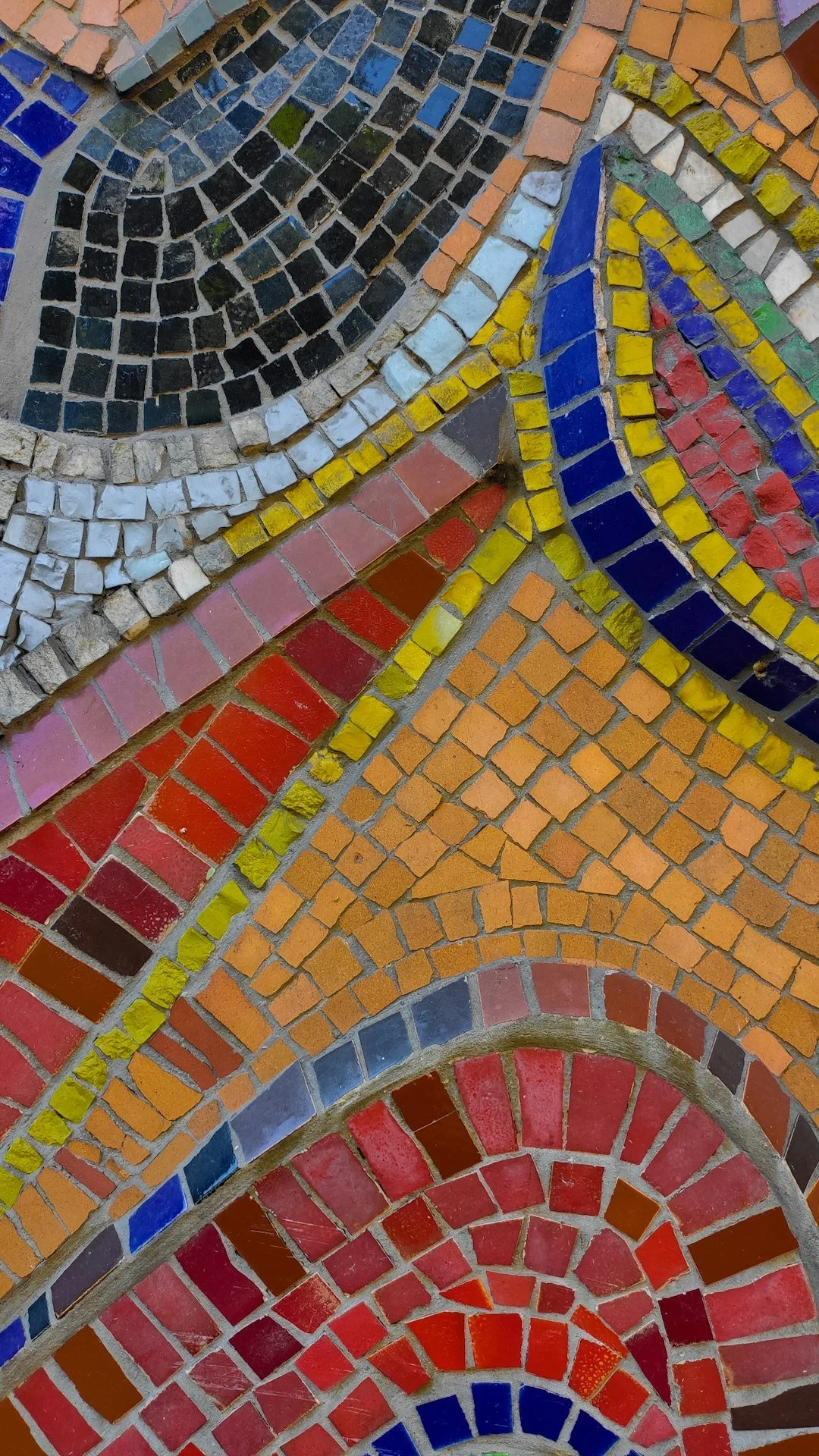
Glass Mosaic Art
For months, a wooden frame sat on my worktable, holding a growing constellation of colored glass. Shards of cobalt, amber, and milky white, each piece fractured from a larger whole. My hands, guided by patience and a vague vision, placed them with tweezers, fitting jagged edge to jagged edge. This is the slow, meditative art of mosaic: taking what is broken and arranging it into a new, coherent beauty. The cracks are not hidden; they are essential. They are the channels where the grout will settle, the lines that give the final image its depth and character.
I was applying the final pieces when the metaphor settled over me, not as a gentle thought, but as a clear, resonant truth. The men who trust me with their time are each a collection of shards. They arrive not as polished, seamless stones, but as mosaics in progress, bearing the fractures of a world that demands wholeness.
Consider the stories cradled in my memory, shared in the safe quiet after the world has been shut out.
The veteran who called himself “broken.” His body, a testament to service, no longer moves as it once did. He spoke the word with a finality that broke my heart. Yet, in his eyes was a kindness forged in unspeakable adversity, and a generosity that flowed not from pity, but from profound understanding. Where he saw damaged goods, I saw a pane of stained glass: a life where light passes through not in spite of the cracks, but because of them, casting complex, compassionate colors.
The executive whose fracture was one of time. His life was a spreadsheet of obligations, a masterpiece of productivity that left no room for the messy art of connection. He wasn’t broken by failure, but by success. His shards were minutes and hours, and his loneliness was the silent space between them. He sought guaranteed companionship not out of laziness, but out of a desperate, efficient need to feel real in his few unclaimed moments.
The devout man cast out by his congregation for the crime of a question. His faith, once a solid pane, was now a pile of sharp, confusing pieces. His fracture was spiritual, a rupture between the community he loved and the conscience he could not silence. He came seeking not absolution, but simply a space where his doubt wouldn’t be met with damnation.
The gentleman yearning across a racial line, paralyzed by the silent rules of the culture that raised him. His fracture was one of desire versus dogma. He held pieces of two different pictures in his hands, told they could never fit together, aching for a design no one had given him permission to create.
The recently divorced man, whose entire vision of his future, the promised, seamless portrait of marriage and family, had fallen from the wall and shattered. His pieces were mismatched expectations, lost dreams, and the terrifying blank space of starting over.
Society, work, culture, religion: they are all hammers in their own way. They tap us, sometimes gently, often with force, and we break along the lines of our unique pressures. We are told to hide the damage, to pretend we are still a single, unblemished sheet. We walk around feeling like a bag of sharp edges, a hazard to ourselves and others.
But in the studio, and in my practice, I work with a different philosophy.
You are not a problem to be solved. You are a composition to be witnessed.
Each of you, with your distinct fractures, is a crucial piece in a far grander mosaic. It is the mosaic of this era, of silent struggles, quiet courage, and the universal search for a place where one’s pattern makes sense. Your loneliness, your feeling of being “broken,” is the grout that connects you to every other person feeling the same way. It is what allows the larger picture to hold together.
This is the heart of my selectivity. I am protective of my energy not because I seek perfect, unbroken individuals, but because I must protect the sanctity of my metaphoric creative space. This must be a space where the glass can be laid out, examined without fear, and appreciated for its unique color and cut. My openness is not a lack of standards; it is a focused acceptance. I accept that you come with fractures. I accept that your story has sharp edges. I do not promise to glue you back into your original form… that is not my role. I promise to see the beauty in your current arrangement.
So, you arrive at my door, a collection of exquisite shards. We will spend our time not hiding your breaks, but exploring the pattern they currently make. In the conversation, the companionship, the shared quiet, a new understanding of your own design can emerge.
The world may see a pile of broken glass. I see the beginning of a masterpiece.
I look forward, truly, to experiencing the piece of art that you are.