The Ephemeral Canvas
On Henna, History, the Art of Temporary Adornment and the Gentlemen Who Trace Them
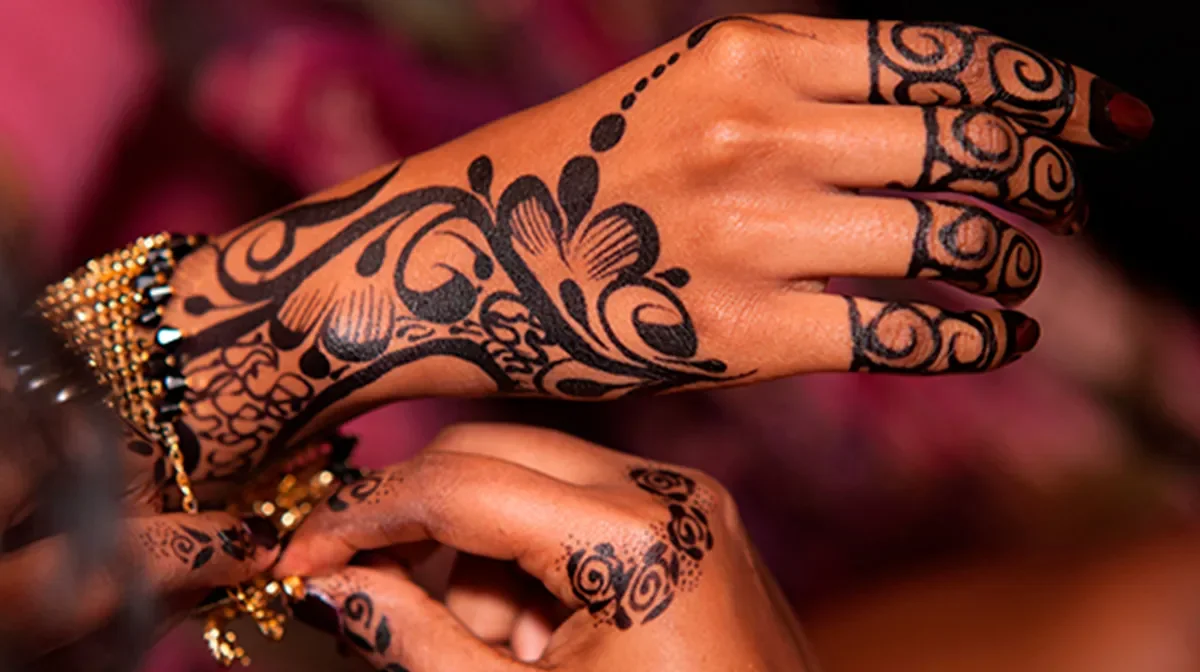
Henna art on hands
It’s your second time seeing me...
The evening begins with the familiar comfort of easy conversation, a shared glass of something golden. A well-aged bourbon, perhaps? And then your gaze catches my wrist, where last time a delicate mandala bloomed. Today, it is bare. Your eyes drift to my ankle, and there it is: an intricate lattice of swirling lines, dark against my skin, where no such pattern existed before.
You pause. You are too refined to ask directly, but curiosity flickers across your face. Finally, with the hesitation of a man who does not like to admit uncertainty, you ask, “What happened to your tattoo?”
I smile. This is my favorite question.
“Nothing happened to it,” I say. “It simply… left. It was never meant to stay.”
You look again, closer now. The design is flawless, professional, clearly the work of a steady hand and practiced eye. Yet it is also clearly, unmistakably, not permanent. The edges are slightly raised, the surface matte. A faint, earthy sweetness, camphor and rose perhaps, lingers near the art.
This is henna. In Nigeria, we call it Laali among the Yoruba, or Lalle in Hausa. And its impermanence is its most elegant feature.
I understand, completely, the preference some discerning gentlemen have for companions without permanent ink. It speaks to a taste for the classic, the unmarked, the canvas in its pure state. My practice honors that preference. Henna offers the best of both worlds: the bold statement of body art and the profound respect for the pristine canvas. It is adornment as a conversation, not a commitment; a whisper, not a shout. It fades, faithfully, in one to three weeks, leaving no trace but the memory of its beauty.
And you, it seems, are beginning to remember.
You ask about the color, why it is so dark, almost black, unlike the reddish-brown designs you recall seeing on vacation in Morocco or India. Another excellent question.
This is the distinct signature of Nigerian henna, particularly in the North, where the tradition runs deep. While North African and South Asian henna stains a warm, coppery red, the Laali of my heritage is engineered for depth. A faint orange mark might vanish against deeper complexions. For countless years, women across Nigeria shaped a solution - deepening the hue through time-tested methods. They chose powerful henna leaves, let the mixture sit until pigments unlocked fully. Resting gave strength. Then came small additions: potash, sometimes lemon, maybe indigo - each nudging the tint darker. The result? A glossy, almost black finish that holds stories in its sheen.
It is not merely decoration. It is technology. Artistry refined by necessity, ensuring the design commands the eye with the same elegance and clarity on any canvas, under any light.
But its purpose runs deeper than aesthetics.
In the Nigeria of my grandmothers, Laali was never applied in silence. It was a ritual, a gathering. Women would assemble, their laps filled with cones of fragrant paste, and take turns adorning one another’s arms and legs. Each pattern carried meaning. At wedding times, the Kamu ritual marks how the bride changes. Her skin, along with arms and legs, gets painted in Laali - done by her aunties - showing she has stepped into womanhood, prepared to start married life. Drums sound out while flutes add their voice; singing rises from women sharing tunes carried forward across time.
Stories were woven into the lines. Blessings were pressed into the skin along with the dye. The henna was not just art; it was a document of a woman’s life, her joys, her milestones, her community.
There is even a legend about the Hausa people’s origins that involves henna. The story goes that the Hausa communities are descendants of Bawo, a son conceived when the Queen of Daura, previously dedicated to celibacy, dyed her hands and feet with Laali and adorned herself in perfume and jewelry to seduce her husband Bayajida, the prince of Baghdad. Henna, then, is not merely cosmetic. It is the stuff of dynasties.
So when I sit alone in quiet preparation before our date, cone in hand, I am continuing that lineage. I am not merely decorating myself; I am curating an offering. The pattern I choose is selected with you in mind. Bold or delicate? Centralized or trailing? A statement or a secret? Each line is a decision, each flourish a note in the silent composition of our evening.
And then you arrive. And something remarkable happens.
You notice. You always do. Your eyes find the fresh design within moments of entering the room. And then, inevitably, your fingers find it too.
There is a particular intimacy in the way a man traces henna. It is not a hurried touch. It is exploratory, almost reverent. Your fingertip follows a curling vine, pauses at a flower, presses gently against the raised, drying paste. You are not merely touching me; you are reading me. The pattern becomes a map, and your hand the explorer.
I love this moment. The slight friction of the design under your skin, the shared focus on a detail so intricate and fleeting, the unspoken acknowledgment that this beauty was made with you in mind. It transforms touch from mere sensation into a form of shared archaeology: you are unearthing the layers of tradition, ritual, and personal choice that adorn me for our time together.
This is the secret I offer you.
The Laali you trace tonight will fade. In a week, perhaps two, those dark lines will soften to ghostly sepia, then vanish entirely. My skin will return to its pristine, unmarked state, ready for the next story, the next design, the next gentleman’s curious hands.
But you will remember. Your fingers will remember the texture, your eyes will remember the contrast, your mind will recall the moment you learned that the most profound beauty is not that which endures, but that which is deliberately, exquisitely, temporary.
This is what sets me apart. Not just the art itself, but the philosophy behind it. That I honor tradition while honoring your preferences. That I adorn myself not for permanence, but for presence. That every line I draw is an invitation: Touch me. Explore me. Be here, now, fully, because this moment will not come again.
Some gentlemen ask if I take commissions. They request specific patterns, certain motifs, designs that hold personal significance. I am always delighted to oblige. Your story, woven into mine, pressed into my skin for a fleeting fortnight. What could be more intimate than that?
Others simply watch, fascinated, as I apply the paste in the quiet hour before we begin. The slow, steady pressure of the cone, the careful construction of symmetry, the meditative silence of creation. They tell me later that this, too, was part of the experience. That watching art emerge from intention was its own form of seduction.
Whether you trace, commission, or simply observe, the invitation is the same.
My skin is a clean slate, waiting for the next story. The cone is full, the paste is fresh, and the traditions of my grandmothers - the Laali of the Yoruba, the Kunshi of the North, the lalle of the Hausa - are ready to meet the curiosity of a gentleman like you.
What pattern shall we create together?And more importantly, will you be here to trace it before it fades?