The Portrait in the Square
On Being Seen Through Someone Else's Lens
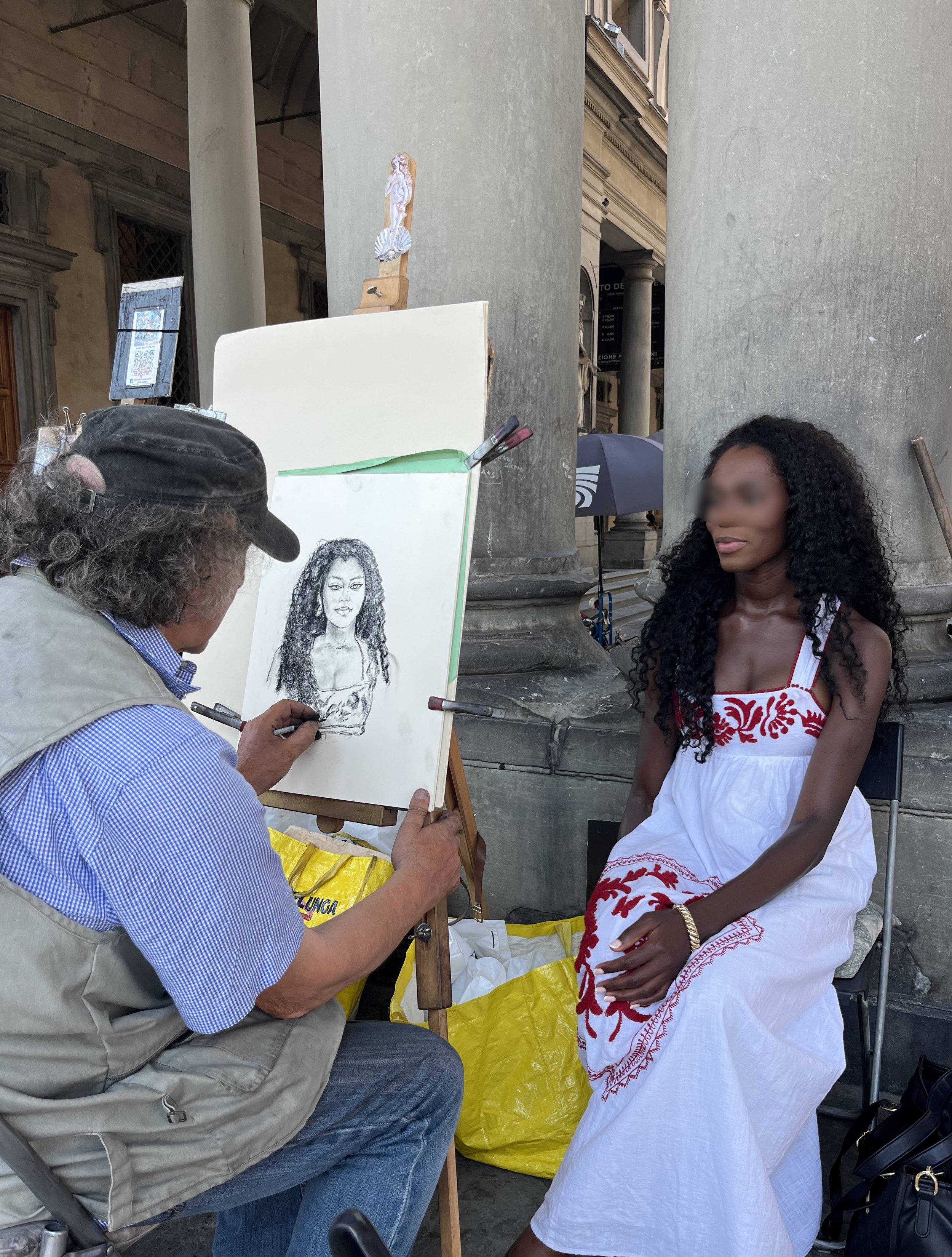
Portraid Session in Florence, Italy
The flight gods I had just returned from the Amalfi Coast, my skin still glistening from the shea butter I had slathered on that morning. The sun had been generous, gifting me a deep, rich tan that seemed to glow against the white linen dress I had thrown on. I made my way through the crowded streets of Florence, my mind already mapping out the day. Three goals: an affogato from the TikTok-famous Vivoli Affogato Bar, a visit to the Museo Galileo, and then, a reunion with the gentleman from Rome who would take me to the Tuscan countryside.
The affogato came first. It lived up to the hype, a perfect juxtaposition of hot espresso and cold, creamy gelato. I needed the caffeine boost to propel me through the rest of my itinerary, and it delivered. Fortified, I made my way to the Museo Galileo.
The exhibition that had drawn me there was called Mirabilia Graphica. A collection of antique microscopes, each one a small, beautiful testament to human curiosity. I have loved microscopes since I was a child. The ability to see beyond what my eyes could perceive, to uncover a hidden world, to be let in on a secret that no one else could see. It felt like a special invitation, a private audience with the invisible.
That same impulse, I realized, is what drew me to biomedical engineering. And, oddly, to companionship. Both are about detail, about seeing what others might miss, about being present to something intimate and unobservable to the outside world.
I lingered at the museum longer than I had planned, tracing the delicate brass details of each microscope, imagining the hands that had held them, the discoveries they had enabled. The exhibition was a quiet reminder that the smallest things often hold the most wonder.
When I stepped out, the sun had shifted, and the square was alive with the buzz of tourists and vendors. I crossed the path to where a row of artists had set up their easels, selling sketches of the Duomo and quick portraits of passersby. I had no intention of stopping. I was on a mission.
But then I saw the little girl.
She sat on a small stool, her blonde ringlets tumbling around her face as a street artist worked intently on her portrait. Her mother stood nearby, watching with quiet pride. I heard the little girl speak to her mother in Croatian: she wanted a snack. I smiled and, in my halting Croatian, told her mother she was beautiful. The mother’s face lit up with surprise. “You understand?” she asked. I told her about my brief stint in Croatia as a child, how I had loved the seaside and the warmth of the people.
We spoke for a few minutes as the artist continued his work. I asked if they were nearly done; I had been thinking about getting a portrait of my own. The mother explained that the artist had recommended solo portraits. Perhaps he wanted her to have something for herself, separate from her daughter; a reminder that she was still an individual, not just a mother. Or perhaps he simply wanted to double his profit. I could not quite tell from his face, and that unsettled me. I am usually good at reading people.
I stepped away, giving them space, and wandered through the streets for nearly thirty minutes. When I returned, the seat was empty. The mother and daughter were gone. And the artist was looking at me.
It was my turn.
I have been a muse for as long as I can remember. As a child, my family used to dress me up and tell me I looked like a doll. I was a subject for my friends when they first got digital cameras. I modeled for brands because of my silhouette, and I have been a muse for the gentlemen I see, a canvas for their desires and their attention. And now, here I was, a subject for Marcello, an Italian street artist who would capture me with nothing but coal on paper.
For fifteen euros, I would sit and be perceived.
I settled onto the stool, unsure of what to do. I was used to direction; a photographer telling me to tilt my head, adjust my posture, look this way or that. But Marcello was silent. He worked in silence, his eyes moving between me and the paper with an intensity that felt almost surgical. The only sounds were the shuffle of tourists on cobblestones and the distant hum of the city.
I was forced to sit with my thoughts.
I wondered how he saw me. Did he see me the way I saw myself? Angular, toned, enthusiastic, both playful and serious. I wondered how he would capture my skin. In photography, light can be adjusted to capture the depth of dark brown skin; the warmth, the richness, the subtle undertones. But coal? Coal is not forgiving. It is stark, absolute. I wondered what he would do with that.
Every few minutes, a tourist would pass and stop to admire Marcello’s work. “Beautiful,” they would murmur, and I would find myself uncertain whether they were complimenting me, the muse, or the artist. The ambiguity was strangely freeing. For a moment, I was not the subject of a transaction. I was simply part of a scene.
When Marcello signaled that he was done, I felt a small surge of relief. The portrait had taken about twenty minutes, though it had felt like an eternity. Before I could look at it, I asked a passerby to take a photo of me side-by-side with the portrait. I wanted to see myself as Marcello had seen me.
When I finally looked, I was moved. He had captured the spark in my eyes, the one that appears when I am excited or curious. He had drawn my curls, my widow’s peak, the curve of my collarbones. He had been modest with my bust, generous with my cheekbones. It was me. It was unmistakably me.
But something was off.
My jawline, a feature I have always found distinctly Yoruba… sharp, defined, angular… was softened. It was not as sharp as I knew it to be. I wondered why. I wondered what had made him soften a feature so uniquely mine.
And then I understood.
Marcello was not just capturing me. He was seeing me through his own lens, a lens shaped by decades of living in Florence, by a lifetime of seeing a particular kind of beauty as the standard. He had been born into a world where women like Botticelli’s Venus or the women in Renaissance paintings were the ideal: fuller, rounder, more cherubic. Less angular. And so his hand, guided by his eye, had followed the programming of his culture.
I hold nothing against him. I love the portrait. It hangs in my apartment, a reminder of that day, of that moment. But it is also a reminder that how we are seen is never truly objective. It is always filtered through the lens of the beholder, their culture, their history, their own sense of beauty.
We are all subjects to someone. And we are all perceiving through our own lenses.
It is a lesson I carry with me in my work. When a gentleman looks at me, he is not just seeing me. He is seeing me through the lens of his own desires, his own expectations, his own conditioning. And while I cannot control what he sees, I can hope that he comes to the encounter with curiosity, with openness, and with a willingness to see beyond his own programming.
I sit in my apartment now, looking at the portrait. I see the soft jawline, the high cheekbones, the spark in my eyes. I see myself through Marcello’s lens, and through my own. And I am grateful for the reminder that beauty is not fixed. It is a conversation. It is a question. It is a lens we choose to look through. It is a gift, not just because of what it captured, but because of what it revealed. And I am still learning to see myself through it.
So, if you are reading this, I invite you to consider your own lens. How do you see the women in your life? How do you see yourself? And if you choose to meet me, will you come with an open eye, ready to see what might be different?