The Intimate Archive
On Rain, Braids, and the Gentleman Who Learned My Language
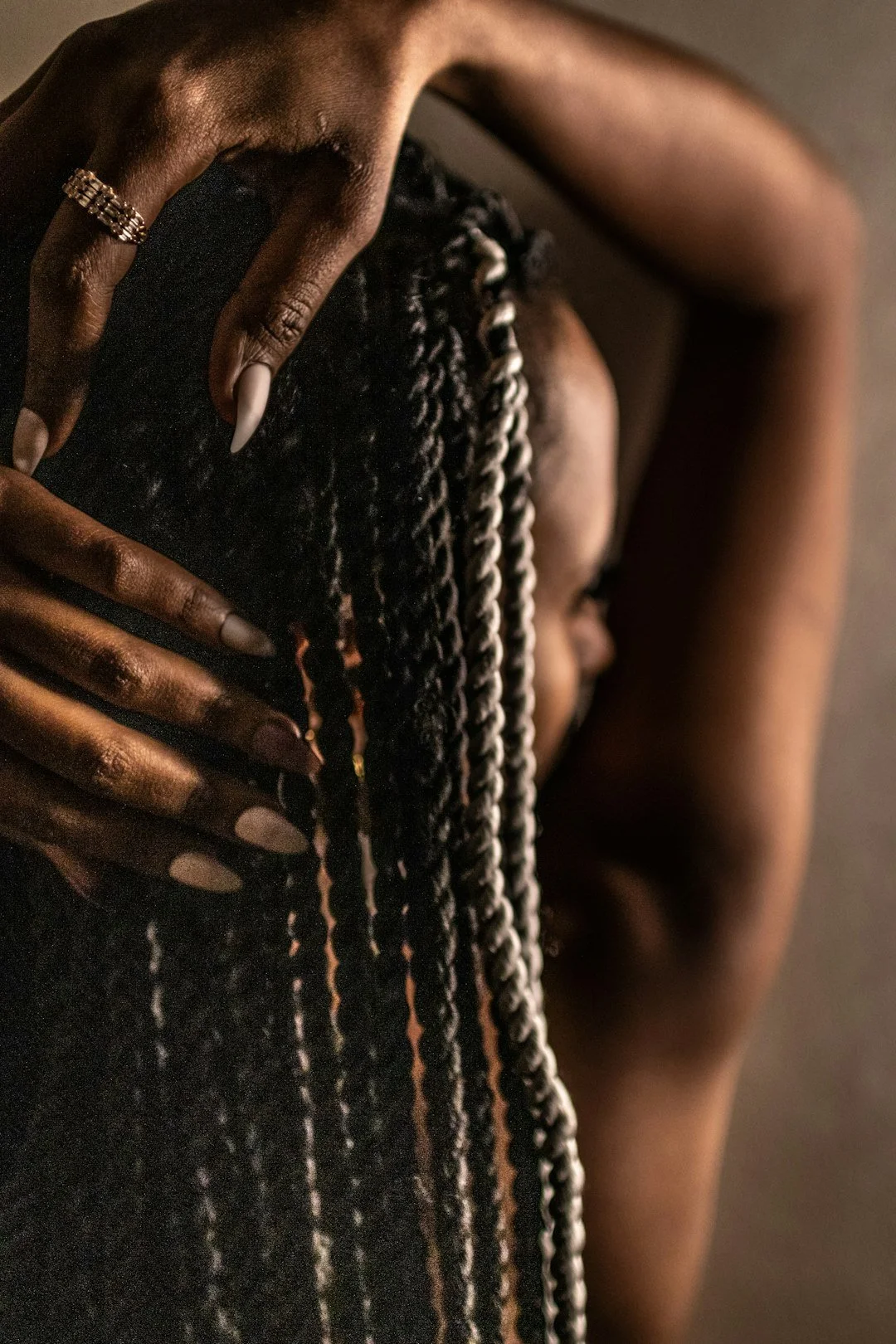
Photo by Michael Starkie on Unsplash
The rain came down in sheets that April afternoon, a persistent, soaking Austin rain that turned the sky the color of pewter and left the air thick enough to drink. I stood at my window, watching the droplets race down the glass, and made a decision. I would not fight the humidity. I would not spend an hour coaxing my hair into submission with a flatiron, only to watch it surrender to the elements before I reached the front door. I would simply be myself.
And so, when he arrived, my hair was not straight. It was not blown out or sleek. It was natural, a magnificent, gravity-defying cloud of tight, resilient curls that sprang from my scalp like something alive. I braced myself, as I sometimes do, for the flicker of surprise, the slight recalibration of expectation.
But his eyes lit up. He smiled, a slow, genuine smile, and said nothing at all about the change. He simply stepped closer, and we began our evening.
To understand why that moment mattered, you must understand the archive. My hair is not merely hair. It is a living document, a rotating gallery of selves I have collected and curated over time. A Nigerian-Haitian woman inherits this language as a birthright. In West Africa, hairstyles have never been mere decoration. For centuries, intricate cornrows and threaded patterns served as a complex text: they could denote marital status, age, ethnic identity, even social standing. To change your hair was to write a new chapter in an ongoing story of the self. The head is a canvas. The hair is the medium. The story never ends.
I met this gentleman for the first time in September, when the Austin heat still shimmered off the pavement and the leaves had just begun to whisper toward autumn. That night, my hair was long ombré braids, brunette melting into blonde, threaded with the colors of a transitioning season: the last oranges of summer, the first browns of fall. They were practical for the Texas heat, yes, but they were also a celebration, a protective style that allowed me to be both glamorous and unbothered by the humidity that would have undone any other effort.
We spoke at length about those braids. He asked questions, genuine ones, about the cultural significance, about the hours of labor, about why I chose those particular colors. He confessed, with a charming honesty, that he had never been with a woman who wore braids. I remember smiling at that, thinking: there is a first time for everything.
That night ended with his hands in my hair, his fingers gently playing with the loose curls at the ends of my braids, a quiet, reverent exploration. He was learning a new language, and his accent was beautiful.
In November, the season shifted, and so did I. The braids had come out, and my hair was straight, sleek, falling in a manner that he later described as reminiscent of a Victoria’s Secret model, framing my face, grazing my cheekbones with every turn of my head. He loved it, he said. He loved how it moved, how it caught the light, how it seemed to have been designed specifically to accentuate the architecture of my face.
I did not tell him then that this version of me was also labor, also intention. The flatiron, the serums, the careful avoidance of moisture. It was not less authentic than the braids. It was simply a different chapter.
And then came April. The rain. The humidity. The decision to stop fighting.
He arrived, and my hair was what it is when no one is watching: a soft, dense halo of curls that shrink to half their length in the wet air, that coil around my fingers, that refuse to be tamed by any product known to woman. He was wowed, genuinely, almost boyishly delighted. He watched as each curl bounced with my laughter, as if they were a silent audience, a chorus of tiny springs that spoke on my behalf. He said it was mesmerizing, how my hair defied gravity, how it seemed to have a personality all its own.
We talked about it, then, the care of it. The deep conditioning, the careful detangling, the silk scarf I wrap around my head at night to preserve the curl pattern. The way it shrinks to a tenth of its length when the humidity rises, a magic trick I never asked to learn.
At one point, I stopped mid-sentence. “You don’t actually care about this,” I said, half-joking. “We can talk about something else.”
He looked at me, and his expression was earnest, almost wounded. “I do care,” he said. “I’ve been researching since our first date. Since I saw you in those braids.”
And then he told me about a company he had decided to invest in, one that sources raw shea butter directly from women’s cooperatives in West Africa. He told me about the supply chain, about the ethical implications, about the key ingredient in Black hair care that he had learned about because of me. Because of a conversation we had months ago, in a hotel room, while his hands played with the ends of my braids.
That level of attention, of intention, swept me off my feet in a way I did not know was possible. It was not grand gestures or expensive gifts. It was a man, quietly, privately, educating himself on a world that was not his own. Not to perform virtue, but because he genuinely wanted to understand. Because he genuinely wanted to see me.
The night that followed was magical, yes. The chemistry was there, as it always had been between us. But what made it transcendent was the safety. The knowledge that he was not merely tolerating my many selves, but witnessing them. Respecting them. Investing in them, quite literally. He saw the braids, the blowout, the natural cloud. He saw the Nigerian-Haitian woman who contains multitudes. And he said, with every word and every touch: I want to know all of her.
Because it is never just hair. Hair is history. Hair is labor. Hair is the texture of grandmothers, the genetic heirloom of sun and resilience. Hair is the choice to be sleek or wild, braided or free. Hair is the question: Will you still recognize me when I change?
He answered that question, months ago, with his curious fingers. He answered it again in November, with his appreciative gaze. And he answered it in April, with his research, his investment, his insistence that he cared.
I am an open book, written in many beautiful scripts. The braids are one language. The blowout is another. The natural curls are the original text, the one I return to when the rain falls and the world feels heavy. I do not expect every gentleman to invest in shea butter cooperatives. But I do hope for the quiet miracle of being seen. Of having my changing archive met not with suspicion or confusion, but with curiosity and care.
The rain has passed now, for the moment. The humidity will return, as it always does in Austin. And my hair will change again, as it always does. It may be braided, beaded, curled, or blown straight. Each iteration is a choice, a mood, an experiment in self-expression.
You are welcome to admire it. You are encouraged to ask about it. You may even, with permission, feel its texture. In return, I offer you a glimpse into a world of art, history, and identity that is as complex and beautiful as the patterns themselves.
The only secret I keep is which version of me will greet you next. But I can promise you this: whoever shows up, she will be real. She will be present. And she will be delighted to discover that you are still curious.
So consider this your invitation. Come meet the archive. Come learn a new language. Come let your hands, your questions, your attention write the next chapter.
I am here, in all my many heads, waiting to be seen…